Gili Trawangan has something that many holiday destinations have lost.
No traffic jams. No conventional taxis. No motorbikes rushing past you while you're walking to the beach.
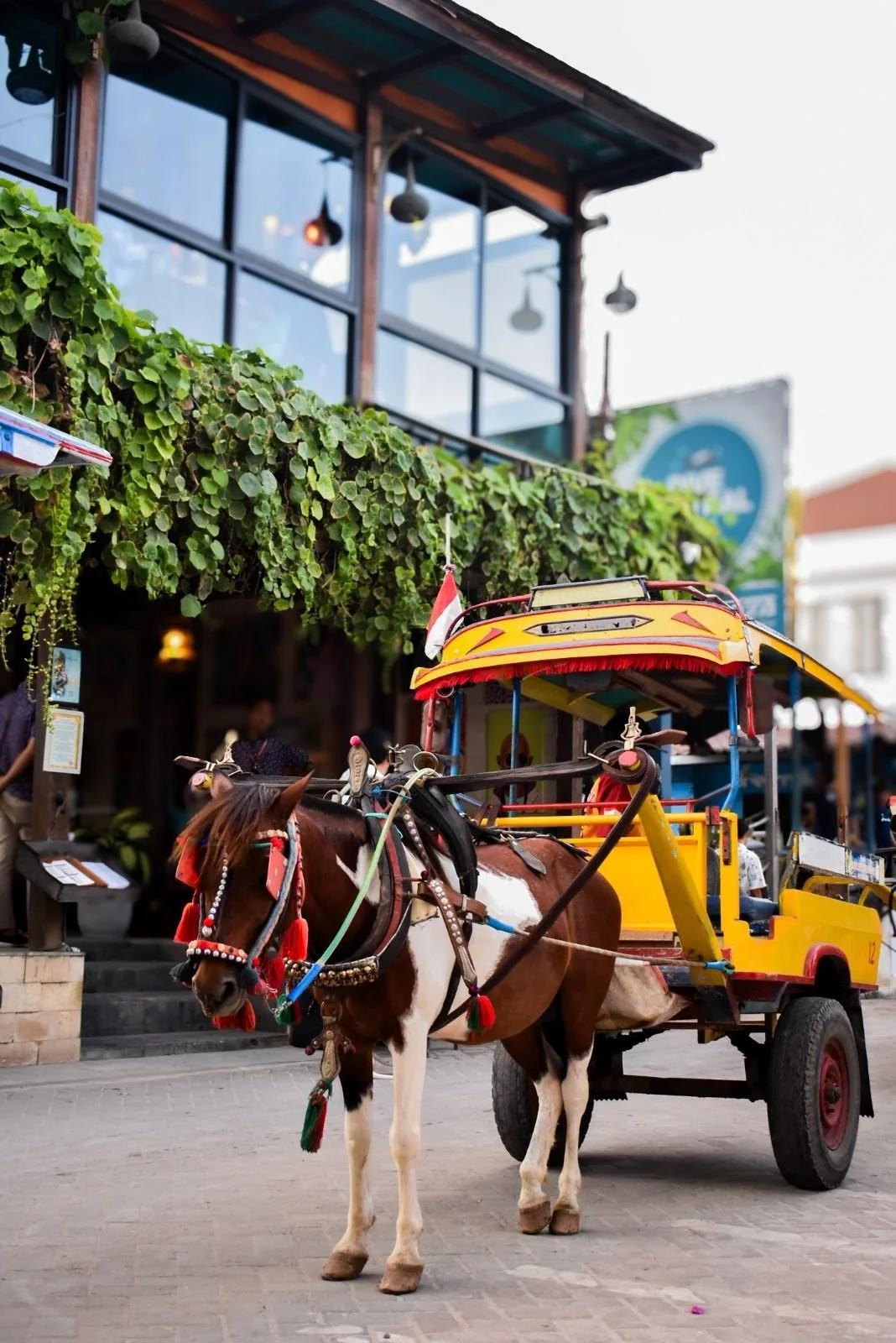
Instead, there are bicycles, pedestrians, and traditional horse-drawn carts known as cidomo.
For some travellers, it's one of the island's most charming features.
For others, it's a reason to question whether they should visit at all.
Spend a little time reading online discussions about Gili Trawangan's horses, and you'll notice something interesting.
The opinions are often completely opposite.
Some visitors describe the horses as well cared for, properly fed, and healthier than critics suggest. Others argue that the use of horses for tourism and transport should stop altogether.
So, who's right?
Are horse carts in Gili Trawangan actually cruel?
Here's what we know: scientific research has documented serious welfare problems among working ponies on Gili Trawangan. But those findings came from research conducted in 2017, and they don't establish the condition of every horse today.
Meanwhile, local organisations continue to provide veterinary treatment, education, and rehabilitation, with documented welfare activities continuing through 2026.
The story is more complicated than a viral photograph might suggest.
And if you're planning a trip to Gili Trawangan, it's worth understanding both sides before deciding how to get around the island.
Why Are There Horse Carts in Gili Trawangan?
First, a little context.
Gili Trawangan is one of three main Gili Islands off the northwest coast of Lombok, Indonesia.
Unlike much of Bali, the island doesn't have conventional car or motorbike traffic.
Visitors generally travel on foot, by bicycle, or by cidomo.
But here's something tourists sometimes overlook.
Cidomo aren't exclusively tourist attractions.
They also play a role in transporting luggage, food, drinking water, and supplies needed by businesses and residents.
A 2019 scientific study of the island's working ponies specifically highlighted their importance to the local economy, including the movement of goods and essential supplies.
And for the drivers, known locally as kusir, operating a cidomo can provide a source of income.
So when someone suggests eliminating horse carts entirely, they're talking about more than removing a sightseeing experience.
They're also raising questions about how goods would be transported and how affected workers would support themselves.
Does that mean horse welfare concerns should be ignored?
Absolutely not.
But understanding why cidomo exist is essential before discussing what should happen to them.
The Debate: Are Gili Trawangan's Horses Mistreated or Well Cared For?
Here's where things get interesting.
In an online discussion about Gili Trawangan's horses, one commenter described having 40 years of experience working with horses in France.
He claimed to have visited the Gili Islands repeatedly over five years and argued that the condition of the horses had improved considerably.
According to his account, the animals were well fed, regularly cared for, and followed by veterinarians.
He also described working periods of approximately four hours, rather than horses being used continuously throughout the day.
That's quite a different picture from the stories about exhausted or mistreated animals that sometimes circulate online.
But another participant in the discussion took the opposite position.
They argued that tourists should reduce their support for activities and businesses relying on horse-drawn transport, including the movement of goods.
Two visitors.
Two very different conclusions.
And both reflect a wider disagreement about responsible tourism in Gili Trawangan.
Can We Trust These Personal Experiences?
Well, we can listen to them.
But we shouldn't confuse personal observations with scientific evidence.
Someone who has worked with horses for decades may notice details that an inexperienced tourist would miss.
Likewise, someone who witnesses an animal struggling may have a legitimate reason to be concerned.
However, neither account can establish the welfare conditions of every working horse on the island.
The claim that cidomo horses generally work four-hour shifts, for example, would require broader and independently verified information before we could present it as a standard practice.
And a photograph of one apparently healthy horse doesn't prove all horses are healthy.
The opposite is also true.
A photograph of one injured animal doesn't establish that every owner mistreats their horse.
So instead of deciding which online commenter sounds more convincing, let's look at the evidence.
What Does Scientific Research Actually Say About Gili Trawangan's Horses?
In July 2019, the peer-reviewed journal Animals published a study titled A Pilot Welfare Assessment of Working Ponies on Gili Trawangan, Indonesia.
The research was conducted by academics associated with Murdoch University in Australia and Udayana University in Indonesia.
Researchers examined 38 working ponies and interviewed 33 cart drivers during May 2017.
The findings raised significant concerns.
Among the animals assessed for the relevant conditions:
Approximately 92% showed hoof or foot pathology.
86.1% had at least one wound.
38% of the subset assessed for movement showed signs of lameness.
Approximately 39.5% were classified as underweight.
The survey also reported that about 30% of interviewed drivers said they would continue working their pony despite signs of injury or illness.
Those are serious findings.
They indicate that welfare problems were not isolated to one photograph or a single complaint within the sample studied.
The researchers also identified limited veterinary access, husbandry knowledge, and the island's remote location as contributing challenges.
But There's One Detail Many Discussions Miss
This research describes conditions observed in May 2017.
The study was published in 2019, but the examinations were conducted two years earlier.
And the sample consisted of 38 ponies, not the island's entire working horse population.
That doesn't make the research unreliable.
It means we need to interpret it correctly.
The findings provide valuable evidence of historical welfare problems.
They do not tell us exactly how many horses are injured, underweight, or receiving proper care in November 2026.
To answer that question confidently, we would need more recent, representative veterinary assessments.
And that's where the discussion becomes more nuanced.
Are Gili Trawangan's Horses Actually Better Cared for Today?
This is probably the question that deserves the most attention.
Because while older research identified significant problems, local welfare programmes haven't been standing still.
Gili Eco Trust describes long-running programmes focused on improving animal welfare across the Gili Islands.
According to the organisation, its team began organising free volunteer veterinary clinics in 2007.
These clinics have provided medical care while helping owners, drivers, and local animal carers develop practical skills.
The organisation also works with Stud Horse Riding & Rescue, which supports horse rehabilitation, retirement care, and education.
Rather than portraying every horse owner as an enemy, these programmes focus on cooperation.
And that distinction matters.
Recent Welfare Efforts in 2026
There are documented developments from 2026 worth mentioning.
In an April 2026 project report, Stud Horse Riding & Rescue described treating ponies with bruised hooves caused by prolonged exposure to sharp coral surfaces.
The organisation explained that affected animals were receiving rest, protective care, and monitoring.
Its August 2026 update discussed managing workloads, allowing rest, and responding to the challenges created by the island's dry and dusty conditions.
Then, in an October 19, 2026 update, the organisation reported that two retired ponies, Rainbow and Mamba, were continuing to receive care at its facilities.
The report also described serious difficulties obtaining fresh water for the horses, sometimes requiring supplies to be transported from mainland Lombok.
These reports are available through Gili Eco Trust's projects on GlobalGiving.
Now, here's the important distinction.
These reports show active welfare initiatives and the condition of animals under the organisations' care. They are not proof that every working cidomo horse on Gili Trawangan is now in excellent condition.
But they're also evidence that the situation is not static.
There are people doing real work to improve it.
And that deserves recognition.
Why Is Horse Welfare So Difficult on a Small Island?
Let's think about the practical side for a moment.
A working horse needs more than a cart and a driver.
It requires suitable nutrition, drinking water, regular rest, appropriate hoof care, well-fitting equipment, and access to veterinary services.
Now imagine providing all those things on a small island where supplies often have to arrive by boat.
It's not always straightforward.
According to Gili Eco Trust, there are no permanently resident veterinarians on the islands, and specialist equine care has historically been difficult to access.
Injured or sick animals may require assistance from mainland Lombok.
The 2026 reports also show how fresh-water availability and seasonal tourism income can affect the resources available for horse care.
None of this excuses neglect.
An injured horse still needs treatment, regardless of how complicated the logistics may be.
But understanding these challenges helps explain why the solution needs to involve veterinarians, animal welfare organisations, owners, drivers, and local authorities.
It's a much bigger conversation than simply telling tourists to stop riding.
Would Boycotting Every Cidomo Actually Help?
Hmm, this is where the controversy gets particularly interesting.
Some travellers believe the most ethical approach is to refuse every horse-cart ride.
Their reasoning is understandable.
If tourists stop paying for horse-drawn transport, demand may decrease.
But others raise another concern.
What happens to the drivers and families who depend on the income?
And what happens to the horses if their owners suddenly lose the financial means to feed and care for them?
A boycott may reduce demand, but that alone doesn't establish whether animal welfare will improve.
The outcome would depend on the alternatives available for transport, employment, and continued horse care.
What About Businesses That Use Cidomo to Transport Supplies?
Here's another complication.
Cidomo transport isn't limited to visitors arriving with suitcases.
The island also relies on moving food, water, and other supplies.
Avoiding one tourist ride is relatively straightforward.
Trying to eliminate every indirect connection to horse-drawn transport is considerably more complicated.
That raises an important question.
Should responsible tourism focus entirely on eliminating demand, or should it also support better working conditions and access to veterinary care?
There isn't a simple answer supported by the evidence reviewed here.
But one thing is clear.
Animal welfare improvements need to be measurable, and changes to local transport should consider the people and animals affected.
That's a more productive starting point than assuming every cidomo is either perfectly ethical or inherently abusive.
How Can Tourists Make a More Informed Decision?
You don't have to settle the entire debate before visiting Gili Trawangan.
But you can make a few practical choices.
Look Beyond the Appearance of the Cart
A beautifully decorated cidomo doesn't automatically mean the horse receives appropriate care.
Look at the animal itself.
Visible wounds, obvious limping, extreme thinness, or apparent difficulty moving are reasons for concern.
However, not all welfare problems are visible to someone without veterinary training.
So appearance is only one part of the picture.
Consider the Load
A cart carrying several passengers and a large amount of luggage places different demands on a horse than a lighter load.
If a cart appears overloaded, avoid adding to it.
Ask Questions Respectfully
You can ask the driver about the horse's working routine, breaks, and care.
The answers may help inform your choice, although they aren't independent verification.
Avoid assuming the worst about an individual simply because they operate a cidomo.
Support Local Welfare Programmes
If horse welfare matters to you, consider learning about the work of Gili Eco Trust and Stud Horse Riding & Rescue.
Their programmes address practical needs such as veterinary care, owner education, hoof treatment, feeding, and rehabilitation.
That's one way to support improvements beyond the duration of your holiday.
Walk or Cycle When It's Practical
If your destination is nearby and you're comfortable walking, you may not need to arrange a horse-cart ride at all.
For longer journeys, cycling may be suitable for some travellers.
But walking and cycling aren't practical for everyone, especially those with mobility limitations or substantial luggage.
Responsible travel should recognise those differences.
Can You Explore Gili Trawangan Without Using a Horse Cart?
Yes.
Many visitors explore Gili Trawangan primarily on foot or by bicycle.
The island's relatively compact size makes this possible, particularly if you plan your activities around where you're staying.
However, some roads and paths have sandy or uneven sections.
The heat can also make longer walks uncomfortable.
So rather than assuming you can walk absolutely everywhere, think about your hotel location.
Where is the harbour?
Where will you eat?
Where is your dive centre?
How far will you need to travel for activities?
And how will you get back after sunset?
These questions can help you decide whether you'll need transport during your stay.
Our guide to exploring Gili Trawangan without a bicycle explains the practical side of getting around the island in more detail.
Does Staying Near Gili Trawangan Harbour Make a Difference?
Actually, yes.
And this is something worth thinking about before booking your accommodation.
Imagine arriving on Gili Trawangan with a suitcase after a fast boat journey from Bali.
Your hotel is located on the other side of the island.
You'll need to decide whether to walk a longer distance, cycle if practical, or arrange another form of transport.
Now imagine your accommodation is only a few minutes from the main harbour.
If you're comfortable carrying your luggage, you may be able to walk directly to your room.
No additional transfer needed.
That can be useful whether you're concerned about animal welfare, travelling on a budget, or simply prefer the convenience of staying close to the island's main arrival point.
Pesona Beach Resort & Spa: A Three-Minute Walk from the Harbour
One example is Pesona Beach Resort & Spa, an adults-only beachfront resort on Gili Trawangan's central eastern coastline.
The resort is approximately three minutes on foot from Gili Trawangan Harbour, according to its official directions.
For travellers with manageable luggage who are comfortable walking, reaching the accommodation without a cidomo is a practical option.
The property also has several facilities within the resort itself.
These include Pesona Lounge Trawangan, a beachfront restaurant serving Indian and international cuisine, Dive Central Gili, a PADI Five Star dive operation, and Azure Wellness & Spa, which provides massage and wellness experiences.
Guests also have access to two swimming pool areas, with different arrangements for leisure and dive training.
This combination means some everyday holiday activities can be enjoyed without repeatedly travelling across the island.
Of course, Pesona isn't claiming that every traveller should avoid cidomo or that choosing the resort solves horse welfare issues.
And we're not suggesting that every visitor can comfortably walk with luggage.
The point is much simpler.
Where you stay can influence how much additional transport you need.
If being within walking distance of the harbour is important to you, explore the rooms at Pesona Beach Resort & Spa or check its official directions.
Is Gili Trawangan Doing Enough to Protect Its Horses?
That's a harder question than it first appears.
We know that welfare concerns have been documented scientifically.
We also know that organisations such as Gili Eco Trust and Stud Horse Riding & Rescue are actively working to improve conditions.
Recent reports show veterinary and rehabilitation efforts continuing in 2026.
But these sources don't provide a complete, independently verified assessment of every working horse on the island today.
And without that, it's difficult to make sweeping claims about the overall success of the improvements.
Perhaps some horses are receiving excellent care.
Others may still face challenges.
Both situations could exist on the same island.
The most useful next step would be more representative, current welfare assessments alongside continued veterinary support, education, and cooperation with drivers.
Because what matters most isn't whether one side wins the online argument.
It's whether the horses' actual quality of life improves.
Frequently Asked Questions About Horse Carts in Gili Trawangan
Are Horse Carts in Gili Trawangan Cruel?
Scientific research has documented welfare problems among working ponies on Gili Trawangan, including wounds and hoof conditions. However, that research used data collected in 2017 and doesn't establish the condition of every horse in 2026. Animal welfare depends on the individual horse's health, care, equipment, workload, and living conditions.
Are Gili Trawangan's Horses Better Cared for Now?
Local organisations report continuing veterinary care, education, and rehabilitation programmes, including activities documented in 2026. These are positive developments, but more recent island-wide research would be needed to measure overall improvements.
Do Cidomo Horses Really Work Only Four Hours a Day?
Some visitors have described four-hour working periods in their personal observations. However, this hasn't been verified as a universal working schedule for every cidomo horse on Gili Trawangan. Individual routines may differ.
Are All Cidomo Drivers Mistreating Their Horses?
No evidence supports that generalisation. Welfare conditions and management practices may vary. Local organisations also work directly with owners and drivers to improve animal care.
Should Tourists Boycott Cidomo in Gili Trawangan?
Travellers can choose not to use horse-drawn transport. However, a blanket boycott has potential implications for local livelihoods and doesn't automatically guarantee improved animal welfare. Supporting credible welfare initiatives and making informed transport choices are other ways to contribute.
Can You Stay in Gili Trawangan Without Using Cidomo?
Yes. Walking and cycling are common ways of getting around the island. Choosing accommodation near the harbour and central restaurants can reduce the need for additional transport.
Where Can I Stay Near Gili Trawangan Harbour?
Pesona Beach Resort & Spa is an adults-only beachfront resort approximately three minutes on foot from the main harbour. It offers rooms for guests aged 16 and above, along with on-site dining, diving, swimming pools, and wellness facilities.
How Can Visitors Support Horse Welfare in Gili Trawangan?
Visitors can learn about the issue, make informed transport decisions, avoid using visibly distressed or overloaded animals, and support organisations involved in veterinary care and horse rehabilitation, such as Gili Eco Trust and Stud Horse Riding & Rescue.
Final Thoughts: Are Tourists Getting the Story Wrong?
Perhaps the biggest problem with the cidomo debate isn't that people care too much.
It's that the conversation sometimes leaves very little room for anything between two extremes.
One side sees cruelty everywhere.
The other insists there's no problem at all.
But the evidence tells a more complicated story.
Gili Trawangan has documented historical horse welfare problems.
It also has people working to improve animal care, with rehabilitation and veterinary initiatives continuing today.
And while some visitors report seeing healthy, well-managed horses, those experiences alone can't establish the condition of the entire population.
So should tourists ignore the controversy?
No.
Should they assume every driver is mistreating an animal?
Also no.
A more useful approach is to stay informed, recognise the island's practical transport needs, and support improvements that benefit both horses and the people who depend on them.
For travellers who prefer walking, choosing accommodation close to the harbour can also make getting around more convenient.
Pesona Beach Resort & Spa, located on Gili Trawangan's eastern beachfront, is one option for guests looking to stay within walking distance of the main arrival point, restaurants, diving, and other island experiences.
But wherever you choose to stay, there's something worth remembering.
Responsible tourism isn't about winning an argument on social media. It's about making better decisions with the information we actually have.
And sometimes, that starts with being willing to question both sides of the story.
